
Buying guide 8 min readUpdated Oct 20, 2026
Commercial VRF on Oahu: When It Beats Split Systems and Rooftop Units
Most small and mid-size commercial buildings on Oahu end up choosing between rooftop package units, a set of split systems, or variable refrigerant flow. Each one wins in some buildings and loses in others. This guide compares them for the kinds of buildings we see around the island, then covers two things with a clock on them: the January 1, 2027 cutoff for installing older R-410A VRF equipment, and Hawaii Energy's rebate of up to $275 per ton.
Written by the Universal Air Hawaii service team, based on AC repairs across Oahu.

The short version
- VRF is usually the strongest choice for buildings with many zones that need different amounts of cooling at different times.
- A like-for-like rooftop unit on an existing curb is often simpler and cheaper for a single open space.
- VRF doesn't bring in outside air, so it needs a separate ventilation plan.
- Larger R-410A VRF equipment made before 2026 has to be installed by January 1, 2027, under EPA rules.
- Hawaii Energy pays up to $275 per ton for qualifying VRF and package or split systems through June 30, 2027.
Hawaii Energy instant rebates, program year through 30 June 2027
Taken off your invoice, not claimed later. First-come, first-served while program funds last. Requires a Hawaiian Electric account, so Kauai (KIUC) is not eligible, and the work must be done by a Hawaii Energy Clean Energy Ally except where noted.
| What qualifies | Rebate | Counted |
|---|---|---|
| Split AC / mini-splitSet by the outdoor unit's size and SEER2 rating: $450 from 8,000 to under 20,000 BTU at 17.2+ SEER2, which covers 9,000 and 12,000 BTU units (they earn nothing below 17.2); $550 starts at 30,000 BTU. Counted per condenser, so three single-zone systems earn three rebates while one multi-zone earns one. Newly constructed homes do not qualify; newly purchased homes do. | $400-$550 | per outdoor unit (condenser) |
| Central AC retrofitOld outdoor unit must be 13.0 SEER or lower and the new one 15.2 SEER2 or better. Pre-approval from Hawaii Energy is required before the work starts. | $1,250 | per system |
| AC tune-upCentral or split. Must be a multi-point tune-up performed by a Clean Energy Ally. | $75 | per condenser, up to 2 a year |
| ENERGY STAR window ACInstant at participating retailers; no contractor needed. The higher amount is for dual-inverter models. | $25-$45 | per unit |
Amounts verified October 2026 against Hawaii Energy's published residential cooling rebates. Program funds are limited, so confirm before you buy.
On this page
Most small and mid-size commercial buildings on Oahu end up choosing between rooftop package units, a set of split systems, or variable refrigerant flow. Each one wins in some buildings and loses in others, and a poor fit tends to show up years later in power bills and tenant complaints.
This guide from Universal Air Hawaii compares the three for the kinds of buildings you find around the island. It also covers two things with a deadline attached: the January 1, 2027 cutoff for installing older R-410A VRF equipment, and Hawaii Energy's rebate of up to $275 per ton, which runs through June 30, 2027.
01The three options in plain terms
A rooftop package unit, or RTU, puts everything in one box on a curb on the roof. It pushes cooled air down through ducts, and it can pull in outside air at the same time. Hawaii Energy says rooftop units make up the majority of AC systems in Hawaii businesses.
Split systems pair one outdoor unit with one indoor unit, or a few. They're the same kind of equipment as in a house, sized up for a shop or an office suite.
Variable refrigerant flow, or VRF, connects one outdoor system to many indoor units through refrigerant piping. The compressor speeds up and slows down to match what the building needs at that moment, and each indoor unit has its own controls. Most Oahu buildings only ever need cooling, so cooling-only or heat pump VRF covers nearly all of them. Heat recovery models, which can heat some rooms while cooling others, usually aren't worth the extra cost at sea level here.
02How they compare
| Rooftop package unit | Split systems | VRF | |
|---|---|---|---|
| Zone control | One thermostat per unit, usually covering a large area | Room by room | Many zones, each with its own controls |
| Efficiency at part load | Depends on the model; older units cycle on and off | Good with inverter models | Strong, since the compressor modulates to match the load |
| Ductwork | Needs ducts | None | Little or none, with short ducts only for ducted indoor units |
| Fresh air | Can bring in outside air itself | None | None; needs a separate ventilation system |
| Up-front cost | Often lowest per ton when replacing on an existing curb | Low for a few rooms, adds up quickly | Usually the highest of the three |
| Replacement disruption | Crane lift and a short shutdown | One space at a time | Indoor work can often happen while the old system runs |
| Service | Widely serviced | Widely serviced | Best handled by technicians trained on that manufacturer |
Hawaii Energy's business HVAC page puts the savings from an inverter VRF system at 20 to 35% of energy use. Where a building lands in that range depends on how much of the day it spends at part load, which is where VRF does its best work.
03Where VRF tends to win
An office floor with a sunny west side and windowless interior rooms is a good example. At 3 p.m. the west offices need a lot of cooling and the conference room in the middle needs very little. A single rooftop unit cools them all to one thermostat. VRF lets each zone take only what it needs, and the outdoor unit slows down to match.
Older walk-up buildings without space for ducts are another. Refrigerant piping fits through much smaller openings than ductwork, which makes VRF possible where a ducted system would mean tearing out ceilings.
VRF also suits multi-tenant floors where each suite wants its own controls, and buildings that run long hours half full, like clinics with staggered appointments.
Need a pro to take a look?
We'll find the cause, show you photos and quote a flat price before any work starts.
04Where something else makes more sense
A single open space with an existing curb and good ductwork, such as a retail box or a small warehouse, is often best served by a new rooftop unit. A like-for-like swap is simpler, faster and cheaper, and a new unit will usually beat a 15-year-old one on efficiency by a wide margin.
A space with only a few rooms, like a small office or a dental suite, may be better off with a handful of split systems. They're easy to service and quick to replace one at a time.
Spaces that need a lot of outside air, such as restaurants with kitchen exhaust, need a serious ventilation plan whichever system cools them. A rooftop unit can handle both jobs in one box. A tenant on a short lease, or an owner who plans to sell soon, may not stay long enough for VRF's efficiency to pay back its higher first cost.
05Ventilation is a separate job
VRF moves heat with refrigerant and recirculates the air already in the building. Outside air for occupants has to come from somewhere else, usually a dedicated outdoor air system or energy recovery ventilators. Leave that out of the plan and the rooms will be cool but stuffy, and the project may not pass review.
Hawaii Energy added a new rebate this year of $0.15 per kWh for direct expansion dedicated outdoor air systems, but only in new construction. Commercial projects may also need Department of Health review of air conditioning and ventilation, which DPP lists among the agencies that may need to sign off alongside a building permit.
06Salt, sun and rooftops
Oahu roofs are hard on outdoor equipment. Near the shore, ask for factory coil coatings and corrosion-resistant hardware, and plan for regular fresh-water rinses. Our salt air guide explains why coastal coils fail early.
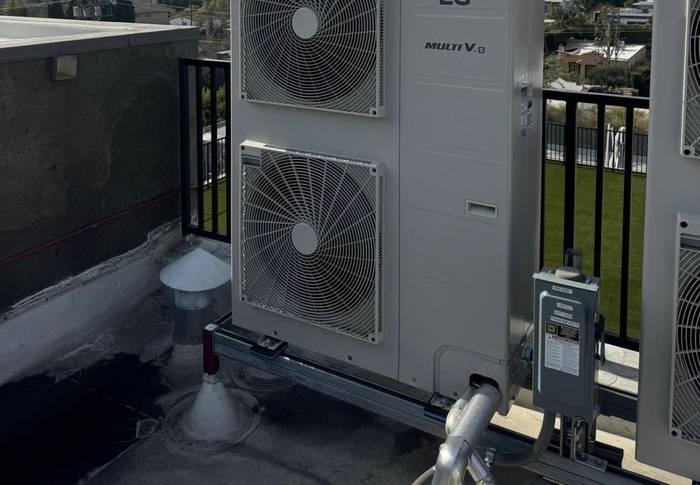
Setting VRF outdoor units on rails keeps them off the roof membrane, lets water drain underneath and leaves room to reroof later. A fused disconnect at each unit lets a technician isolate one module without shutting down the rest.
07The refrigerant deadline for VRF
Federal rules under the AIM Act are moving air conditioning away from high global warming potential refrigerants like R-410A. For VRF, the EPA's final rule from December 2024 set these dates:
- New VRF systems manufactured or imported from January 1, 2026, must use a refrigerant with a GWP under 700.
- VRF equipment using R-410A that was made or imported before January 1, 2026, can still be installed, but only until January 1, 2027.
- Projects with a building permit approved before October 5, 2023, have until January 1, 2028.
The restrictions cover air-source VRF systems of 65,000 BTU per hour and up, plus water-source VRF of any size, according to industry coverage of the rule. The EPA's May 2026 revisions eased the deadlines for residential and light commercial systems, but the VRF dates above weren't among the changes listed.
If you're planning an R-410A VRF project from existing inventory, the install has to be finished by January 1, 2027, which leaves very little time. New VRF systems use lower-GWP refrigerants that are mildly flammable, and depending on the room sizes and how much refrigerant the system holds, they can call for design changes such as leak detection. Existing R-410A systems can still be serviced. Our R-410A guide covers repairs on older equipment.
08Rebates
Hawaii Energy's 2026–27 program pays up to $275 per ton for qualifying VRF systems, and the same for package and split AC. Packaged and split units have to be at least 10% more efficient than the current energy code. A 20-ton system at the full rate would earn $5,500.
Check the equipment against Hawaii Energy's eligibility worksheet before you order it, and get the paperwork moving early. Funding is first-come, first-served through June 30, 2027.
09Planning a replacement
A commercial changeover goes better when the hard questions get answered before equipment is ordered.
- Survey what's there: curbs, ducts, roof structure, electrical service and where piping could run.
- Run a load calculation zone by zone, so each indoor unit is sized for the space it serves.
- Decide how outside air will be handled.
- Agree on a phasing plan with tenants, so cutovers happen after hours or on weekends.
- Line up permits and any Department of Health ventilation review.
- Set up a maintenance schedule before the warranty clock starts.
Regular AC maintenance matters even more on VRF, because a dirty coil or a clogged drain on one indoor unit can show up as a fault across the system.
10Talk to us about your building
We install both kinds of system, from the Multi V units pictured above to rooftop package units set on new curbs with fresh flashing and trapped condensate lines, so we can price them side by side for your building.
If your equipment is near the end of its life, call or text (808) 400-6593 or see our commercial AC page, and we'll walk the roof and the electrical service with you before recommending anything.
Common questions
More AC guides
Hawaii know-how
Hawaii Energy AC Rebates for July 2026 to June 2027: What Qualifies and How They're Paid
Hawaii know-how
Salt Air and Your AC: Preventing Corrosion on Oahu's Coast
Buying guide
R-410A Phaseout: Should You Repair or Replace Your AC on Oahu?
Services that fix this
Commercial
When the AC quits, your customers, staff and inventory feel it first. Universal Air repairs, replaces and maintains commercial air conditioning across Oahu, with work scheduled around your business hours.
Learn moreVRF / VRV Systems
Variable refrigerant flow systems cool many rooms from shared outdoor equipment, with precise zone control and no bulky ductwork. We design, install and service VRF and VRV systems for offices, clinics and condo towers across Oahu.
Learn moreRooftop & Package Units
Rooftop and package units take a beating from Oahu sun, salt and humidity. We repair, maintain and replace RTUs for businesses across the island, with planned work that keeps your doors open.
Learn moreMaintenance Agreements
Scheduled maintenance keeps your air conditioning running, your costs predictable and your records in order. We build commercial AC maintenance agreements around your equipment, your building and your budget, anywhere on Oahu.
Learn moreHot house? We're on the way.
Book online in under a minute, call, or text. One local team for every neighborhood on Oahu.