
Hawaii know-how 7 min readUpdated Oct 20, 2026
Where Can Your AC Condenser Go? Oahu Noise Limits and Placement Rules
Hawaii's Department of Health counts an outdoor AC unit as a stationary noise source. In residential areas it can't be louder than 55 dBA during the day or 45 dBA at night, measured at the property line. On a tight lot in Kapolei or a condo lanai in town, where the outdoor unit goes decides whether that limit ever becomes your problem.
Written by the Universal Air Hawaii service team, based on AC repairs across Oahu.

The short version
- Hawaii's noise rule names air conditioning units as stationary noise sources.
- Residential limits are 55 dBA from 7 a.m. to 10 p.m. and 45 dBA overnight, measured at or beyond the property line.
- In condos and townhouses, the property line can fall between your unit and your neighbor's.
- In open air, noise from an outdoor unit drops about 6 dB each time the distance doubles, but walls and corners bounce it back.
- Placement, a quieter model and night mode solve most noise problems before anyone needs a sound meter.
Typical fully installed split AC prices on Oahu
Market ranges for a complete installation, not a quote for your home. A complete price includes equipment, line set, electrical, permit where required, mounting, wall work, removal of the old unit, start-up and GET.
| System | Installed price |
|---|---|
| Single-zone (one indoor head) | $3,500–$7,500 |
| 2 zones | $7,000–$11,000 |
| 3-4 zones | $10,000–$15,000 |
| 5+ zones | $15,000–$22,000 or more |
Oahu market ranges as of October 2026. Rebates below come off these figures.
Hawaii Energy instant rebates, program year through 30 June 2027
Taken off your invoice, not claimed later. First-come, first-served while program funds last. Requires a Hawaiian Electric account, so Kauai (KIUC) is not eligible, and the work must be done by a Hawaii Energy Clean Energy Ally except where noted.
| What qualifies | Rebate | Counted |
|---|---|---|
| Split AC / mini-splitSet by the outdoor unit's size and SEER2 rating: $450 from 8,000 to under 20,000 BTU at 17.2+ SEER2, which covers 9,000 and 12,000 BTU units (they earn nothing below 17.2); $550 starts at 30,000 BTU. Counted per condenser, so three single-zone systems earn three rebates while one multi-zone earns one. Newly constructed homes do not qualify; newly purchased homes do. | $400-$550 | per outdoor unit (condenser) |
| Central AC retrofitOld outdoor unit must be 13.0 SEER or lower and the new one 15.2 SEER2 or better. Pre-approval from Hawaii Energy is required before the work starts. | $1,250 | per system |
| AC tune-upCentral or split. Must be a multi-point tune-up performed by a Clean Energy Ally. | $75 | per condenser, up to 2 a year |
| ENERGY STAR window ACInstant at participating retailers; no contractor needed. The higher amount is for dual-inverter models. | $25-$45 | per unit |
Amounts verified October 2026 against Hawaii Energy's published residential cooling rebates. Program funds are limited, so confirm before you buy.
On this page
Hawaii's Department of Health counts the outdoor half of your AC as a stationary noise source. In residential areas it can't be louder than 55 dBA during the day or 45 dBA at night, measured at the property line. On a tight lot in Kapolei or a condo lanai in town, a poorly placed unit can go over that without anyone noticing until a neighbor does.
Where the condenser goes usually decides whether the rule ever becomes your problem. This guide from Universal Air Hawaii explains what the state rule says, how to read the noise rating on a spec sheet, which spots around a home work best, and what to do if a complaint comes in.
01What the state rule says
Hawaii's noise limits come from Hawaii Administrative Rules chapter 11-46, the Department of Health's community noise rule. Its definition of a stationary noise source specifically names mechanical air conditioning units, so the outdoor half of your split AC is covered.
| Zoning class | Includes | Day, 7 a.m. to 10 p.m. | Night, 10 p.m. to 7 a.m. |
|---|---|---|---|
| Class A | Residential, conservation, preservation, public space, open space | 55 dBA | 45 dBA |
| Class B | Multifamily, apartment, business, commercial, hotel, resort | 60 dBA | 50 dBA |
| Class C | Agriculture, country, industrial | 70 dBA | 70 dBA |
A few details in the rule matter more than the numbers.
The limit applies at any point at or beyond the property line. For condos, townhouses and duplexes, the rule draws that line between units owned by different people. Between two buildings sharing common grounds, it's the midpoint between them. A condenser on your lanai can be measured at your neighbor's lanai.
The unit can go over the limit for no more than 10% of any 20-minute period, so a short burst at start-up isn't the issue. Steady noise all night is.
Enforcement uses proper sound level meters, and a reading only counts if the source is more than 3 dB louder than the background noise. Violations can bring fines of up to $10,000 per offense, with each day counted separately.
This is a plain-language summary, not legal advice. For a specific dispute, read the rule itself or contact the Department of Health.
02Reading the noise rating on a spec sheet
Forty-five dBA at night is a low number. Plenty of outdoor units are louder than that a few feet away, so the spec sheet and the distance to your property line both matter.
Ductless outdoor units are usually rated by sound pressure, in dB(A), measured at a set distance from the unit, often about a meter. Central AC condensers are more often rated by sound power, which describes the total noise the machine puts out. Sound power numbers come out higher and can't be compared directly with sound pressure, so make sure you're comparing like with like.
Distance helps a lot. In open air, the sound from a unit drops by roughly 6 dB each time you double the distance. A unit rated 50 dB(A) at one meter works out to about 44 at two meters, 38 at four and 32 at eight.
Real yards aren't open air, though. A unit tucked into a corner, or against a wall with a fence a few feet away, sends sound bouncing between hard surfaces and reads louder than that math suggests. A narrow side yard between two houses can act like a hallway.
The rated number is also taken under test conditions. On a hot Ewa or Kapolei afternoon, an inverter unit ramps up and gets louder. Many models have a quiet or night mode that caps fan and compressor speed overnight, which is often enough to stay under 45.
How it sounds matters as well. Every 10 dB increase sounds roughly twice as loud to most people, and a tonal hum or rattle bothers neighbors far more than a steady whoosh of air at the same level.
03Picking a spot
| Location | Noise risk | Other things to weigh |
|---|---|---|
| Open rear yard | Usually the lowest | A longer line set can add cost |
| Wide side yard, away from neighbors' windows | Low | Keep the airflow clearance the manufacturer calls for |
| Narrow side yard between two houses | Higher, since sound bounces between walls | Often the only option on newer lots; a quieter model helps |
| Wall bracket | Can pass vibration into the wall | Needs rubber isolators and solid anchoring |
| Roof | Can carry over fences to a neighbor's second floor | Roof penetrations, service access, more sun and salt |
| Condo lanai | Close to the neighbor's lanai, which may be the measuring point | AOAO rules, and heat building up on an enclosed lanai |
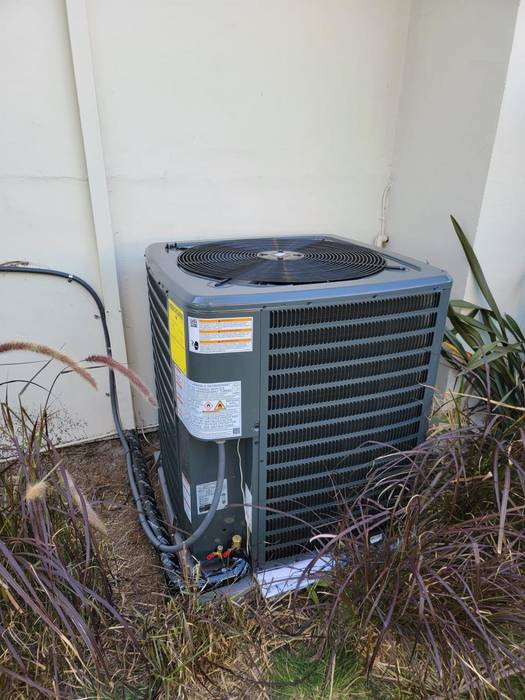
Before settling on the spot with the shortest line set, look at where the neighbors sleep. Moving a condenser ten feet along the house and away from a bedroom window costs a little more copper. Moving it after a complaint costs a lot more.
Give the unit room to breathe. A condenser hemmed in by walls or plants pulls in its own hot exhaust and has to work harder, which makes it louder. Set it level on a solid pad or bracket with vibration isolators, and leave space for a technician to reach the service valves and the disconnect.
Need a pro to take a look?
We'll find the cause, show you photos and quote a flat price before any work starts.
04Setbacks, permits and community rules
Noise isn't the only rule in play. Adding a circuit for a new system needs a building permit from the city, and the Department of Planning and Permitting administers the Land Use Ordinance, which sets yard requirements. If you're putting equipment close to a property line, check with DPP first.
Many master-planned communities in Ewa and Kapolei also have association design rules about where equipment can go and how it's screened. Condos almost always need AOAO approval, and some buildings restrict lanai installs entirely. Our AOAO approval guide covers what boards typically ask for.
05If a neighbor complains
Talk to them before anyone calls the state. A lot of complaints turn out to be about a rattle or a squeal that's a sign of a problem anyway.
Mechanical noise is the first thing to rule out. A loose panel, a fan motor with worn bearings, debris in the fan or a fan blade rubbing will all make a unit louder than its rating, and so will a dirty coil that keeps it running longer. A service call fixes most of those.
Phone decibel apps are fine for a rough idea, but the state rule calls for Type I or Type II sound level meters, so an app reading won't settle anything.
If the unit is working properly and still too loud, the fixes go roughly from cheapest to most expensive:
- Switch on night mode or a quiet setting.
- Add isolation pads or rubber mounts to cut vibration.
- Put up a solid barrier between the unit and the neighbor, leaving enough clearance for airflow.
- Move the unit to a better spot.
- Replace it with a quieter model.
Our split AC repair team can check whether the noise is a failing part before you spend money on the rest of that list.
06Planning a new install
If you're adding AC or replacing a unit on a tight lot, ask us to walk the property with you before you pick a model. We'll compare the spec sheet numbers with the actual distance to your property line and look at where the sound will bounce, then suggest a spot that works for you and the neighbors.
Call or text (808) 400-6593, or start with our split AC installation page. For condos, see condo AC. If you're still choosing equipment, the best AC for Hawaii and our mini-split sizing guide are good places to start.
Common questions
More AC guides
Buying guide
What Size Mini-Split Do I Need? A BTU Guide for Oahu Rooms
Hawaii know-how
Salt Air and Your AC: Preventing Corrosion on Oahu's Coast
Hawaii know-how
How to Get AOAO Approval for Condo AC in Honolulu
Services that fix this
Split AC Installation
Split AC is the smartest way to cool an Oahu home that was built for the trade winds, with no ducts and no major construction. Universal Air Hawaii designs and installs ductless mini-splits that stay quiet, efficient and protected from salt air.
Learn moreCondo AC
Condo AC replacement in Honolulu comes with building rules, board approvals and shared systems that single-family homes don't have. We replace, install and repair every type of condo AC, from wall sleeves to fan coils, and help prepare the documents your association requests.
Learn moreAC Installation
A new air conditioner is a big decision, and on Oahu the right system can save you money every single month. Universal Air Hawaii sizes, installs and replaces split AC, central and window/wall systems for homes across Honolulu and the island.
Learn moreSplit AC Repair
Blinking lights, water dripping down the wall, or a split AC that just blows warm air: we fix them all. Universal Air Hawaii repairs ductless mini-splits across Honolulu and Oahu, single-zone and multi-zone.
Learn moreHot house? We're on the way.
Book online in under a minute, call, or text. One local team for every neighborhood on Oahu.